The Healing Power of Listening: How Deep Presence Transforms the Brain, the Spirit, and the Human Heart
We live in a world overflowing with noise—notifications, competing responsibilities, and the constant pressure to keep moving. Most of us navigate our days without ever experiencing what it truly feels like to be heard. When we try to talk through our challenges with well-meaning friends or family, we are often met with unsolicited advice, polite interruptions, or quick fixes.
But there is a profound, scientifically supported difference between a casual conversation and a professional, trauma-informed coaching session.
During my graduate studies in Human Services Counseling, I studied the work of communications expert James C. Petersen, who identified a truth many of us intuitively feel: Most people listen to reply—not to understand.
In my coaching practice, I choose a different path. I utilize deep, ICF-aligned listening as an active, transformational tool. This kind of presence doesn’t just feel comforting; it actively rewires your brain, calms your nervous system, and helps you access the deep well of wisdom you already carry.
Let’s explore how this intentional space creates lasting change.
The 80/20 Rule: A Space Designed Entirely for You
In everyday conversation, people naturally trade the spotlight back and forth. But in an International Coaching Federation (ICF) aligned coaching partnership, the dynamic is intentionally shifted:
You speak about 80% of the time. I speak about 20%.
This isn’t an accident—it’s a sacred discipline. When a coach talks too much, the session risks becoming a lecture. By keeping my verbal footprint small and purposeful, you receive something rare in modern life: uninterrupted cognitive white space. This dedicated space allows your mind to slow down, untangle complex emotions, and clearly hear your own inner voice.
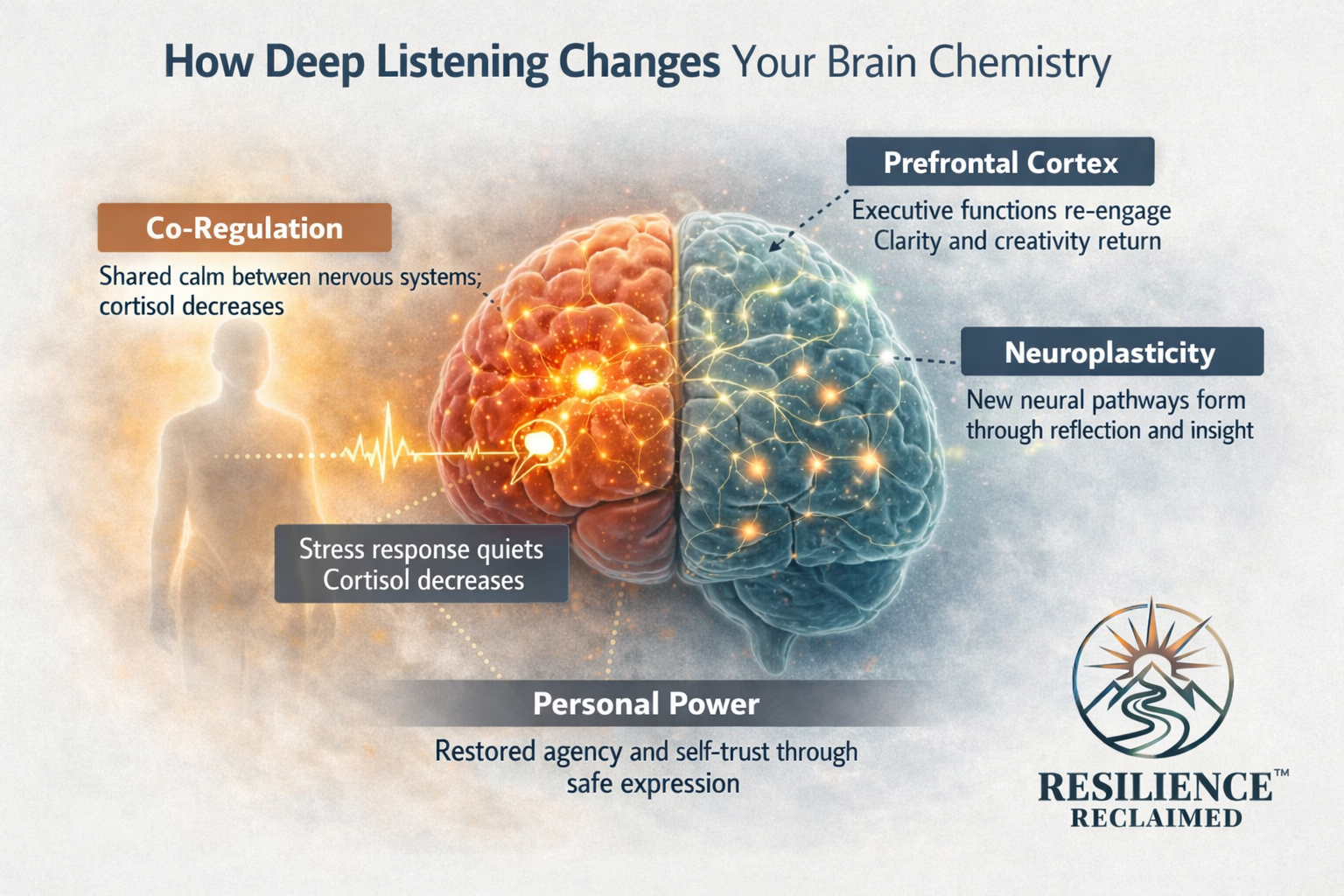
How Deep Listening Changes Your Brain Chemistry
An attuned, trauma-informed presence does more than support your emotional well-being—it creates measurable, neurological shifts.
1. It Calms Your Nervous System (Co-Regulation)
When you feel overwhelmed or stuck, your amygdala—the brain’s alarm center—triggers a fight-or-flight response. Cortisol levels rise, and your body braces for stress. A grounded, non-judgmental coaching presence signals relational safety. Through a biological process called co-regulation, your nervous system takes its cues from a calm environment, allowing your defenses to soften. This shifts you out of survival mode and into a state where healing and insight can flourish.
2. It Re-Engages Your Prefrontal Cortex
As stress decreases, blood flow returns to the prefrontal cortex—the seat of your brain's executive functioning. This area is responsible for:
Strategic decision-making
Emotional regulation
Creativity and innovation
Long-term visioning
Because you cannot access your best thinking while operating under high stress, deep listening acts as the key that unlocks your highest cognitive potential.
3. It Supports Neuroplasticity
When you are invited to speak freely and process aloud without interruption, your brain begins forming new neural pathways. You start to break old mental loops, discover novel possibilities, and shift long-held, limiting beliefs. This adaptability is the literal foundation of sustainable, lasting transformation.
4. It Restores Your Sense of Personal Power
Trauma, burnout, and major life transitions can leave you feeling disconnected from your own voice. When your story is honored without judgment, a powerful shift occurs: you remember that your own inner wisdom is trustworthy. You stop outsourcing your decisions and begin reclaiming your personal power.
The ICF’s Three Levels of Listening
The International Coaching Federation identifies three distinct levels of listening. In our sessions, I intentionally navigate these levels to support your growth, deeply rooted in the ICF Core Competency of Listening Actively.
Level 1: Internal Listening: The focus is on the listener’s own thoughts, judgments, and memories. While everyday conversations live here, a coach only uses Level 1 to notice their own internal filters and intentionally clear them away to return the focus entirely to you.
Level 2: Focused Listening: The attention is completely directed outward, toward you. I am listening intently to your specific words, your vocal tone, your emotional expressions, and the nuances of your unique meaning.
Level 3: Global Listening: This is the deepest, most intuitive level of listening. It encompasses everything in Level 2 while also tuning in to the broader environment—noticing what is not being said, shifts in your energy, underlying values, body language, and the subtle emotional currents beneath the surface.
Blackaby’s Fourth Level of listening includes spiritual
Because my coaching practice beautifully integrates spiritual discernment for clients who desire it, I also draw from Blackaby’s framework. This holistic approach empowers you to listen to God’s voice and movement through four distinct channels:
The Word & Prayer: Grounding your goals in the truths of Scripture while creating a quiet, two-way dialogue to hear God.
Circumstances & Community: Discerning divine direction by noticing the patterns and doors opening in your daily life, and receiving validation through a spiritually mature faith community.
When seamlessly woven into ICF-aligned coaching, these levels of spiritual listening empower you to discern not just what is practical, but what is truly Spirit-led.
My Coaching Philosophy
Coaching is not powerful because I hold all the answers. It is powerful because you hold the answers—and my presence simply creates the perfect environment for them to rise to the surface.
My role is never to "fix" you. It is to walk alongside you as an equal partner, helping you discover the clarity, courage, and direction that already exist within your heart.
Experience the Power of True Presence
Think back to a moment in your life when someone listened to you completely—without interrupting, judging, or trying to manage your problems.
How did your body feel?
How much lighter did your mind become?
That sense of immense relief and sudden clarity is not accidental. It is the natural, biological, and spiritual outcome of being deeply heard. And it is the exact foundation of every coaching session we will build together.
You don’t need to have everything figured out before we meet. You don’t need to be "better," and you don't need to be fixed—because you are not broken. You simply need a safe space where your true voice can rise.
Ready to clear the mental clutter? If you are ready to experience the transformative power of being deeply heard, and to translate that clarity into confident, empowered action, let’s connect. Your next step is already within you. I would be honored to help you hear it
Post‑Traumatic Growth: From Survival to Reclaiming Your Narrative
At Resilience Reclaimed, we believe that while trauma may be part of your history, it does not have to be the end of your story. Our work centers on helping individuals move from the exhausting cycle of survival into intentional, embodied growth.
This is the heart of trauma‑informed coaching: honoring where you’ve been while equipping you to step into who you are becoming.
1. Understanding the Landscape of Trauma
Trauma is a word used often, but in a professional coaching context it has a specific meaning. Trauma is not the event itself—it is the internal imprint left behind. Trauma occurs when an experience overwhelms the nervous system’s ability to cope, leaving us feeling fragmented, unsafe, or disconnected from ourselves.
To grow, we must first name the “soil” we are planted in. Trauma exists on a spectrum:
Acute Trauma — Single, world‑shaking events such as accidents or sudden loss.
Chronic & Complex Trauma — Repetitive, prolonged exposure to stress where escape feels impossible.
Relational & Attachment Trauma — Wounds formed within our closest bonds, shaping trust and boundaries.
Developmental Trauma — Early experiences that influence how the nervous system matures.
Medical Trauma — The psychological impact of life‑threatening diagnoses or invasive procedures.
Systemic & Collective Trauma — The weight of living within oppressive structures or generational harm.
Moral Injury — A deep soul‑wound created when core values are violated.
A Note on Discernment: Stress vs. Trauma
Not every painful experience is trauma. Stress challenges us; trauma overwhelms us. Distinguishing the two allows us to meet your experience with the right tools and the right level of support.
2. The Science of Post‑Traumatic Growth (PTG)
First described by psychologists Richard Tedeschi and Lawrence Calhoun, Post‑Traumatic Growth (PTG) refers to the positive psychological changes that can emerge through the struggle with deeply challenging life circumstances.
Why PTG Is Not “Toxic Positivity”
PTG is not about bypassing pain or forcing a silver lining. Toxic positivity says, “Just look on the bright side.” PTG says, “Your pain is real—and growth can still emerge.”
Research shows that PTG and post‑traumatic stress often coexist. Growth does not mean the trauma was a gift; it means you have integrated the adversity into a more grounded, authentic version of yourself.
The Mechanics of Growth
PTG unfolds through a process called Deliberate Rumination—the intentional reflection that helps you rebuild your worldview after it has been shaken. If trauma is an earthquake, PTG is the careful, conscious rebuilding of the foundation.
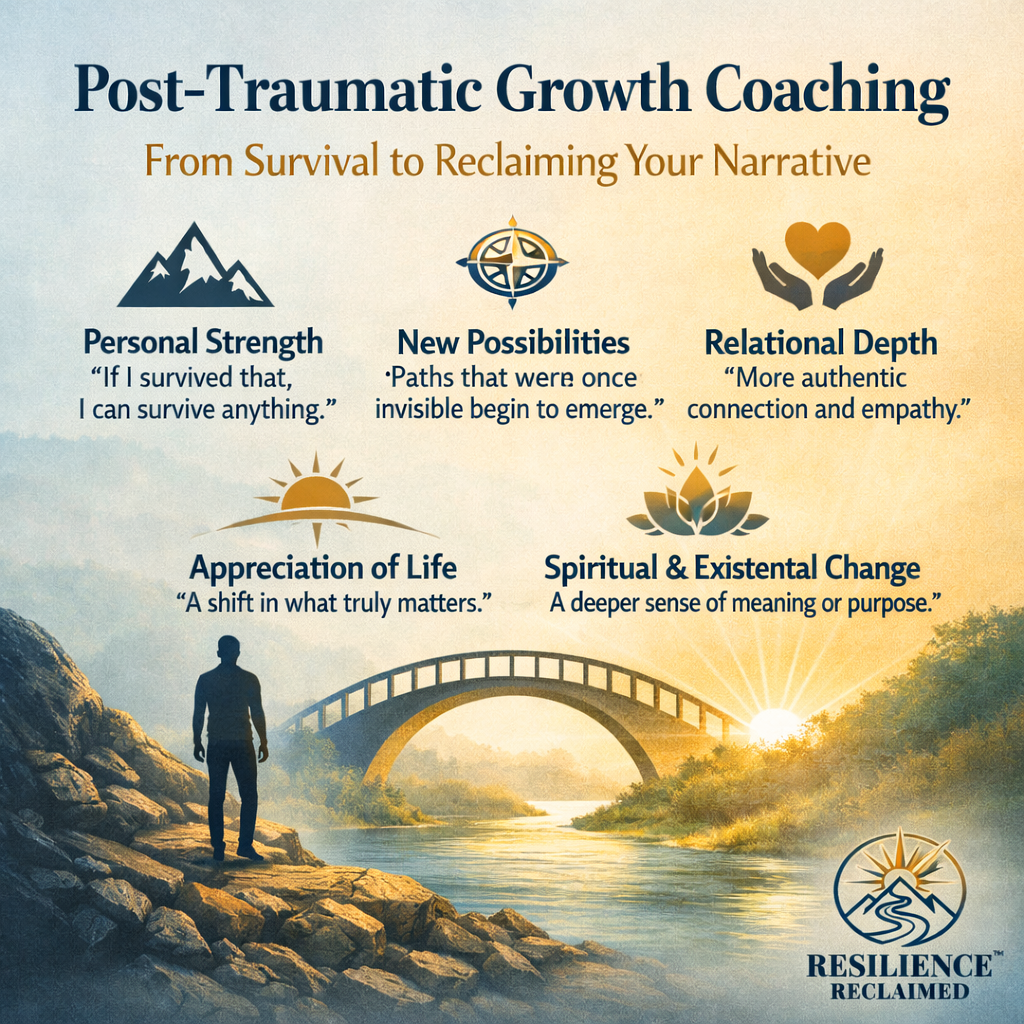
Growth typically appears in five domains:
Personal Strength — “If I survived that, I can survive anything.”
New Possibilities — Paths that were once invisible begin to emerge.
Relational Depth — More authentic connection and empathy.
Appreciation of Life — A shift in what truly matters.
Spiritual or Existential Change — A deeper sense of meaning or purpose.
3. The Bridge: Coaching and Therapy
In alignment with ICF ethical standards, we maintain a clear but collaborative boundary between therapy and coaching.
Therapy is essential for processing the past, treating clinical symptoms (such as PTSD or dissociation), and stabilizing the nervous system.
Coaching serves as an expert companion for growth—helping you stay within your Window of Tolerance and move from survival strategies into values‑aligned action.
4. How Trauma‑Informed Coaching Catalyzes Growth
Trauma‑informed coaching creates the conditions where PTG can take root:
Co‑Creating Safety — A regulated nervous system is the foundation of growth.
Evoking Awareness — Exploring the lenses shaped by your past and discerning trauma‑responses from true intuition.
Identity Reclamation — Moving from “I am broken” to “I am the one who survived—and now I choose how to live.”
Facilitating Action — Growth becomes real through practice: new boundaries, new narratives, new choices.
A Final Word of Hope
Your nervous system is wise—it helped you survive. Your story holds wisdom—it can guide your growth. We don’t “get over” the past; we integrate it.
You are more than what happened to you. You are the architect of what comes next.
Disclaimer: Coaching is a powerful tool for growth but not a substitute for therapy or crisis care. If you experience symptoms of PTSD, dissociation, or emotional instability, please seek support from a licensed mental health professional. Coaching and therapy can work beautifully in tandem.
Ready to Reclaim Your Narrative?
If you’re ready to explore how trauma‑informed coaching can support your journey from survival to growth, I invite you to a Discovery Session—a gentle, no‑pressure conversation to explore what you need and how we can partner together.
Who You Are Is Why You Do: The Cognitive–Emotional–Behavioral Chain
We often approach personal growth like a home renovation project. We focus on the "curb appeal"—the external behaviors we want the world to see. We tell ourselves we need to "just do it," "work harder," or "be more disciplined."
But behavior doesn't exist in a vacuum. It is the final link in a deep, internal sequence. To change what you do, you must first understand who you are being internally.
The Anatomy of the Chain
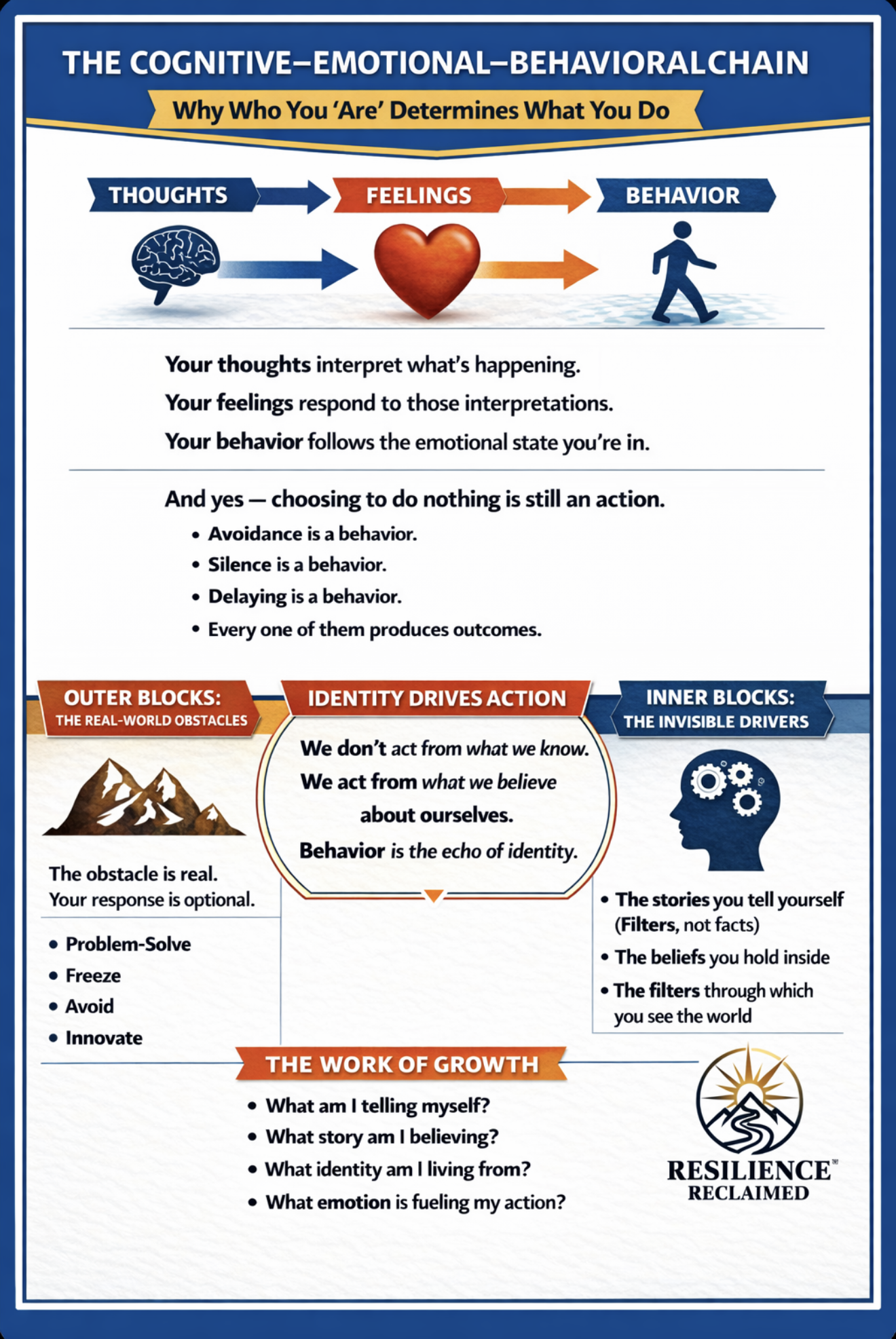
In psychology, your experience follows a distinct flow: Thoughts → Feelings → Behavior.
Thoughts: Your mind is a constant narrator. It interprets every event, interaction, and challenge. It creates the story, builds the assumptions, and sets the default interpretations of your life.
Feelings: Your biology responds to that narration. If your internal story is "I’m out of my league," the feeling is anxiety. If the story is "This is a challenge I was built for," the feeling is focus.
Behavior: Your actions (or inactions) are the echo of that emotional state.
It is a vital distinction to remember: choosing to do nothing is still a behavior. Avoidance, silence, and procrastination are active choices that produce specific, often limiting, outcomes.
The Two Blocks: Navigating Reality vs. Perception
To master change, we must distinguish between the world around us and the world inside us.
Outer Blocks: The Tangible Friction
Outer blocks are situational facts. For example: A literal 24-hour day. No amount of "manifesting" or positive thinking will grant you a 25th hour. The constraint is a physical reality. However, while the block is factual, your response is optional. Depending on your internal chain, that time constraint will cause you to:
Innovate: Prioritize ruthlessly and find efficiencies.
Freeze: Become overwhelmed by the clock and accomplish nothing.
Avoid: Distract yourself with low-value tasks to escape the pressure.
Inner Blocks: The Invisible Drivers
These are the narratives and beliefs you hold about your potential. They aren't facts; they are filters. If your filter is "I am not the kind of person who handles high-stakes pressure," you will subconsciously sabotage opportunities for advancement, regardless of how much "knowledge" or training you possess.
The Core Truth: Identity Drives Action
We don’t act based on what we know; we act based on what we believe about ourselves.
You can read every productivity book on the market, but if your internal identity is "I am someone who never follows through," your behavior will eventually gravitate back to that baseline. Willpower is a depreciating asset; identity is a self-sustaining engine. Behavior is simply the echo of identity.
The Work of Growth: Shifting the Narrative
Transformation doesn't start with forcing new behaviors through grit. That is exhausting and rarely lasts. Real growth begins by auditing the internal drivers.
When you find yourself stuck in a loop of avoidance or frustration, pause and ask:
What am I telling myself about this situation right now?
What story am I choosing to believe is "the truth"?
What identity am I living from in this moment?
What emotion is fueling my current action—or my inaction?
When you shift the internal narrative, the external behavior follows naturally. You stop "trying" to change and start "being" the person for whom the new behavior is the standard.
Ready to break the chain? At Resilience Reclaimed, we help you dismantle the invisible drivers holding you back so you can build an identity that fuels the life you want.
The Science of Transformation: why coaching works
Modern neuroscience has moved beyond theory, providing concrete evidence that coaching isn't just "helpful conversation"—it is a biological catalyst for change. While coaching honors your unique inner world—your purpose, beliefs, and calling—it is deeply grounded in the physical reality of how your brain evolves.
Here is how coaching literally reshapes your mind for success.
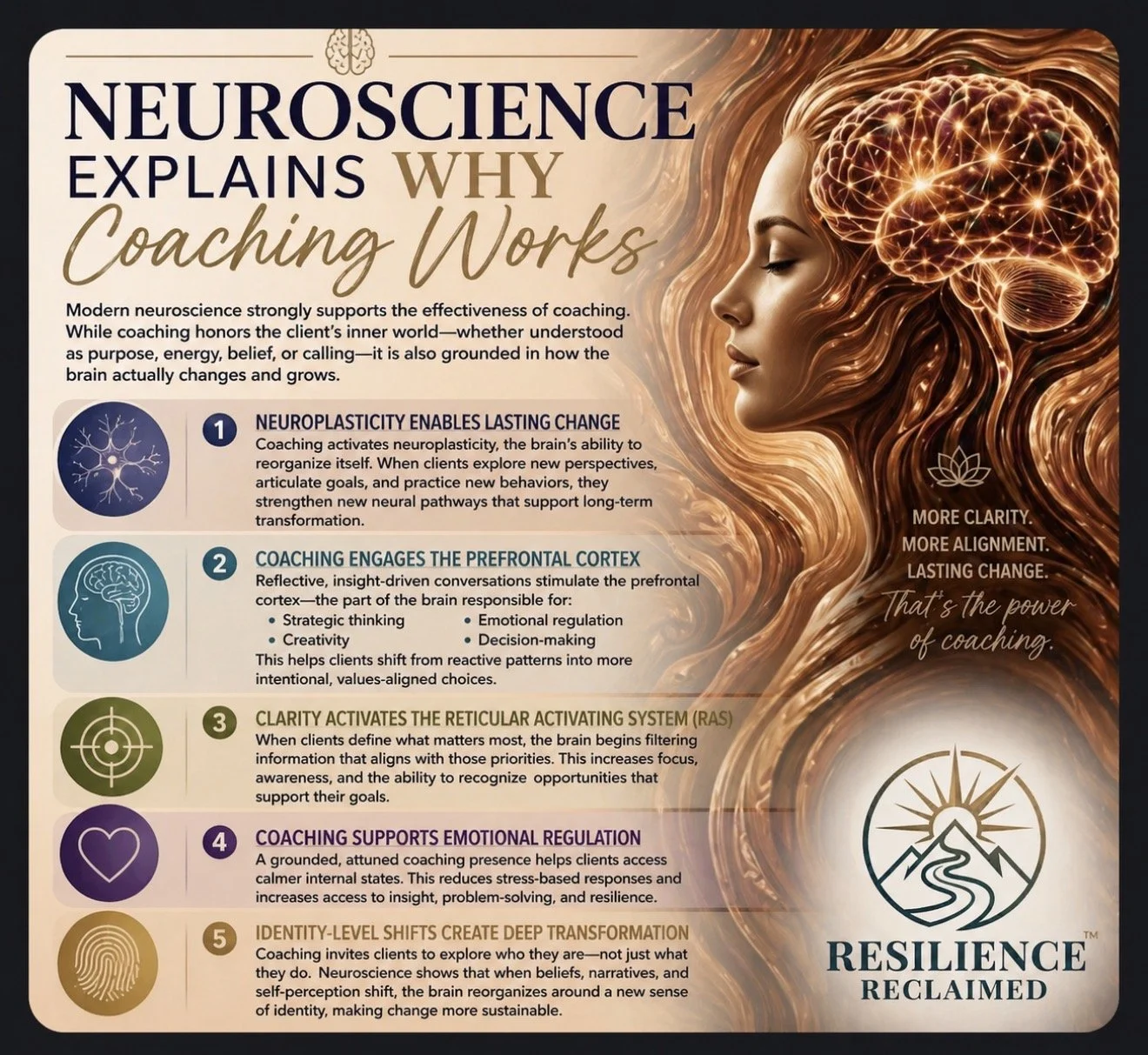
1. Neuroplasticity: The Foundation of Lasting Change
Neuroplasticity is the brain's remarkable ability to reorganize itself by forming new neural connections throughout life.
When you engage in coaching, you aren't just talking; you are building mental "muscle." By exploring new perspectives and consistently practicing new behaviors, you strengthen specific synaptic pathways. Over time, these pathways become the "path of least resistance," making your new, positive habits feel like second nature rather than a constant uphill battle.
2. Engaging the Executive Brain
Coaching shifts the "driver" of your behavior from the reactive, emotional centers of the brain to the Prefrontal Cortex (PFC). This is the seat of high-level executive function, responsible for:
• Strategic Planning: Looking beyond the immediate moment.
• Emotional Regulation: Managing impulses and stress.
• Cognitive Flexibility: Finding creative solutions to old problems.
• Values-Aligned Decision-Making: Choosing what serves your long-term goals over short-term comfort.
3. Tuning Your Internal Filter (The RAS)
Ever notice how when you decide to buy a specific car, you suddenly see it everywhere? That is your Reticular Activating System (RAS) at work.
In coaching, we get hyper-clear on your goals and values. This "programs" your RAS to filter out the noise and highlight the opportunities, resources, and information that were always there but previously ignored. Clarity creates a biological focus that turns "luck" into a repeatable process.
4. Moving from Stress to Insight
When we are stressed, our "fight-or-flight" response (the amygdala) effectively hijacks the brain, shutting down our ability to think creatively.
A grounded, attuned coaching relationship provides a "psychologically safe" environment. This safety lowers cortisol levels and activates the parasympathetic nervous system, allowing you to access deeper insights and more resilient problem-solving states that simply aren't available when you're in a state of high stress.
5. Identity-Level Shifts
The most profound change happens not at the level of what you do, but who you believe you are.
Neuroscience shows that our "self-narrative" is a powerful organizing principle for the brain. When coaching helps you shift deep-seated beliefs and narratives, your brain physically reorganizes its networks to align with this new identity. This makes transformation sustainable because you are no longer "trying to change"—you are simply acting in alignment with who you have become.
The brain can change. So can you.
Science explains the process. Coaching transforms the results.
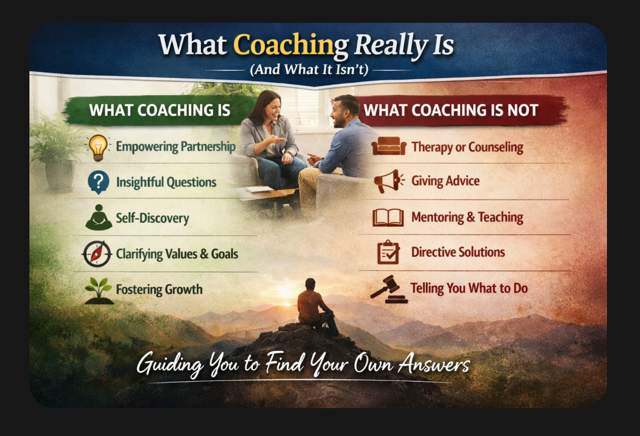
Is Coaching actually just “advice” (spoiler: NO!!!)
What Coaching Really Is
If you’ve ever wondered what coaching actually is, and what it definitely isn’t, you’re not alone. Coaching gets talked about often, but it’s just as often misunderstood. When you see what it truly offers, it becomes one of the most empowering tools for personal and professional growth.
Coaching is a supportive partnership that helps you think more clearly, tap into your strengths, and move forward with confidence. It’s a space where you discover your own answers, rather than someone telling you what to do.
What Coaching Is
Coaching is a professional, collaborative partnership that supports clients in expanding awareness, clarifying values, and taking intentional action toward meaningful goals.
* Treats the client as creative, resourceful, and whole
* Uses powerful questions, reflection, and insight‑oriented dialogue
* Helps clients access their own wisdom rather than providing answers
* Encourages alignment between inner purpose, beliefs, and outward behavior
* Creates a confidential, supportive environment that fosters growth
* Invites clients to explore how their thoughts, emotions, beliefs, and sense of meaning influence their choices and leadership
This approach honors both the client’s inner life and their capacity for conscious, intentional action, allowing them to lead and live with clarity, integrity, and purpose.
What Coaching Is Not
* Therapy, counseling, or mental health treatment
* Consulting, advising, or telling clients what to do
* Mentoring based on the coach’s expertise
* Training, teaching, or performance evaluation
* Directive guidance about personal, professional, or spiritual decisions
Coaching does not diagnose, fix, or prescribe solutions.
Instead, it empowers clients to generate their own insights and take ownership of their path forward.
Curious to Explore Coaching?
Reach out if you'd like to schedule a discovery call and see if coaching is right for you. We’d be honored to support you as you explore your next steps.
In Partnership,
Resilience Reclaimed
“Where resilience is your way forward”